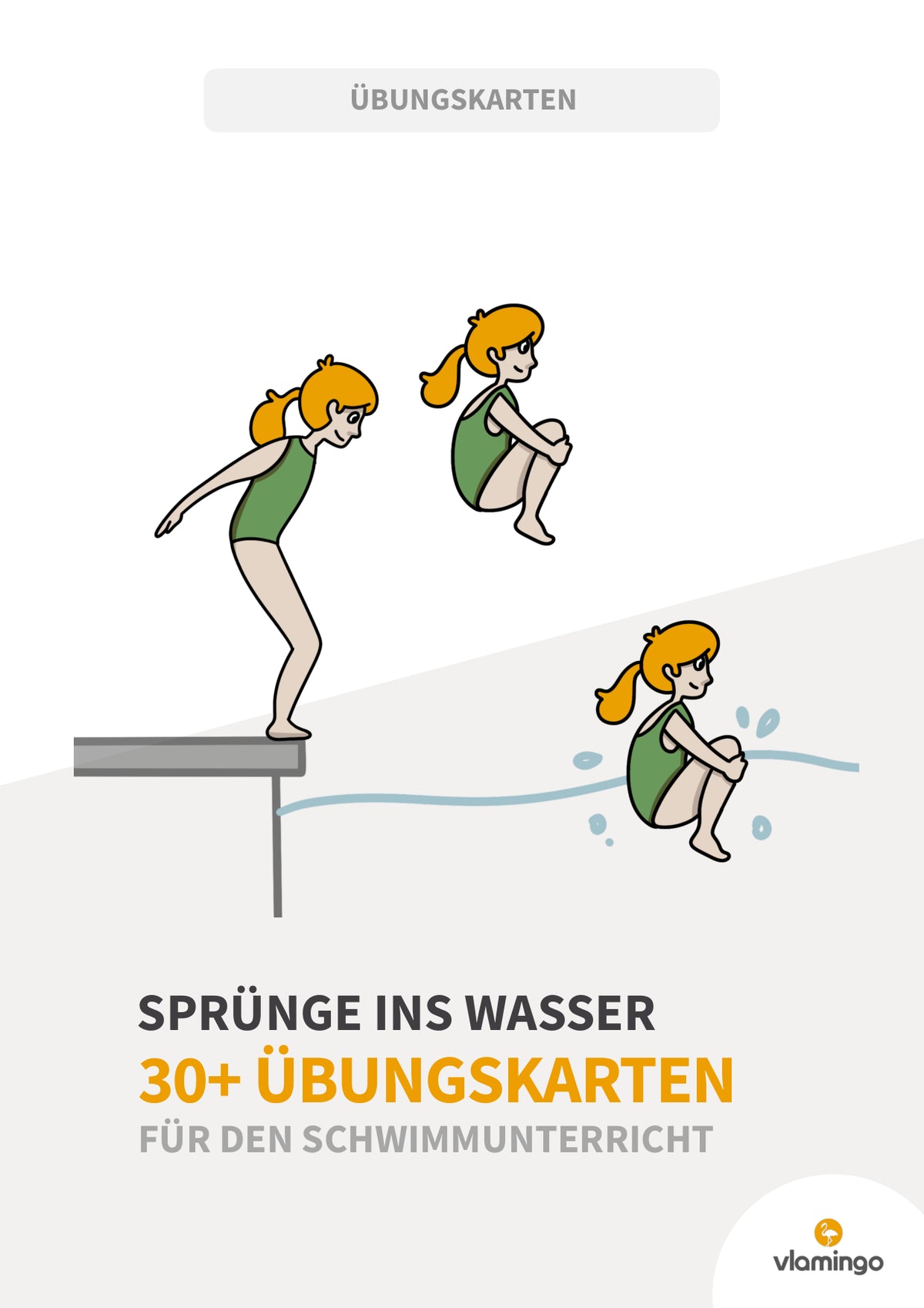


Jumping into the Water: 30+ Practice Cards for Swimming Lessons
Regular price
€7,99
Sale price
Regular price
Tax included.
Product details
- Schulform:
- Primary school and Lower secondary school
- Jahrgangsstufe:
- 1. Klasse – 10. Klasse
- Fach:
- Sports
- Themenbereich:
- Schwimmen, Tauchen & Wasserspringen
- Thema:
- Wasserspringen
- Materialtyp:
- Practice and Task Cards and Technique Cards
- Format:
- Digital download
- Umfang:
- 77 Seiten
Couldn't load pickup availability
Description of the material
With these exercise cards, children and young people in swimming lessons will learn all kinds of jumps into the water – from the simple foot jump to the somersault. Learners can jump over a kickboard, drop into the water as a package, dare to dive headfirst through the ring, or jump off together hand in hand. Most exercises can be performed from the pool edge, the starting block, or the diving board.
What is included in the material
- Exercise cards for foot jumps, package jumps, headfirst dives, rolls and cannonballs, somersaults and versatile fun jumps, each with a task and illustration
- Tip cards for headfirst dives, start jumps, back starts, forward somersaults and backward somersaults, showing the movement sequence step by step
- Overview of the jumps, organized by area and with the respective task
- Mini-competition with questions such as “Who can jump the furthest?” or “Who makes the fewest splashes?”
- Documentation as a table with columns for foot jumps, package jumps and headfirst dives, each from the pool edge, from the starting block and from the diving board
- Station signs with numbers
- Instructions on learning the jumps and using the cards
Tips for using the material
- Approach it gradually: It is recommended to start with low jump heights and gradually increase the height; the learners' skill level and previous experience determine the pace.
- First jumps: At first, it can help to look straight ahead, jump with slightly bent legs and practice the movement sequence slowly and without arm swing at first.
- Target on the water: A board, a pool noodle or a ring on the water surface can serve as a target when learning the jumps.
- The first headfirst dive: The pool edge is ideal for the first attempt because many learners are less afraid there; the technique is often easier from an elevated position such as the starting block.
- Too easy? Those who find an exercise easy can try the more difficult version on the same card, for example, a greater distance from the ring or a full somersault instead of a half somersault.
- Station-based approach: The exercise cards can be used for a station-based approach, where learners complete various jump exercises in pairs or small groups.
- Hold up the card: When explaining a task, the teacher can hold up the appropriate tip or exercise card – this quickly makes it clear what matters and saves the teacher's voice in the swimming hall.
- Free minutes: If the last few minutes of the swimming lesson are free, laid out or hung up cards can provide ideas for their own movement tasks.
These competencies are promoted
- Jump technique for foot jumps, package jumps and headfirst dives, rolls and somersaults
- Body tension when entering the water stretched out and when stretching after a package jump and somersault
- Rotations in the air for half and full somersaults, rolls and somersaults
- Courage to gradually approach higher jumps and the headfirst dive
- Cooperation in pairs when holding, throwing and jumping together in the partner exercises
Organizational notes
For many exercises, no or only little material is needed, such as kickboards, rings, pool noodles or a ball.
To match this, there is a Jump Challenge for swimming lessons, exercise cards for diving and water familiarization, as well as games for swimming lessons.
Included in the following resource package:

Teaching materials at a glance


×
‹
![]() ›