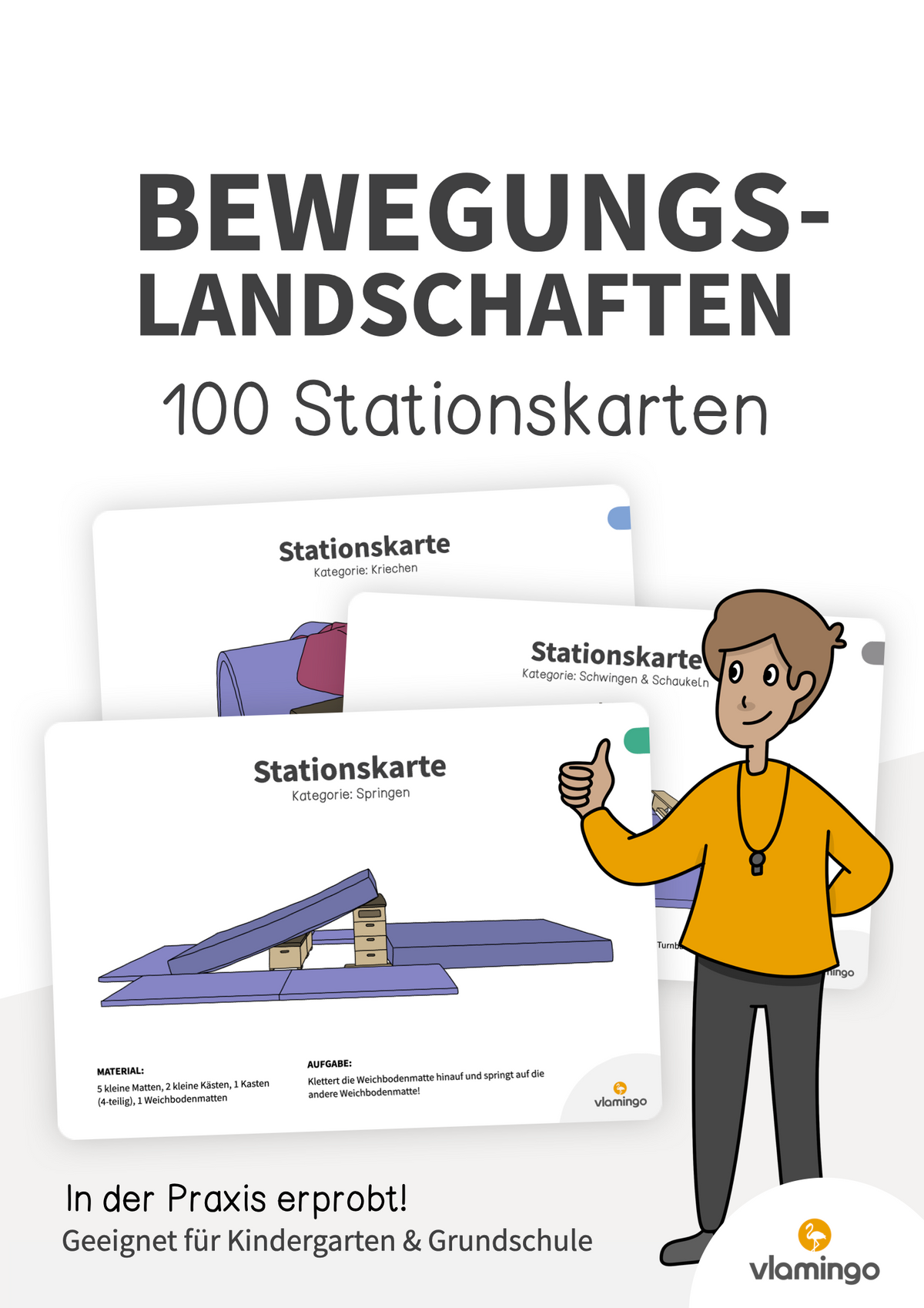
Fighting & Wrestling: 30+ Station Cards and Supporting Materials for Physical Education
- Schulform:
- Lower secondary school and Primary school
- Jahrgangsstufe:
- Grade 3, Grade 4, Grade 5, Grade 6, Grade 7, Grade 8, Grade 9, and Grade 10
- Fach:
- Sports
- Themenbereich:
- Kämpfen & Ringen
- Materialtyp:
- Station Cards, Rule Cards, Technology Cards, and Worksheets
- Format:
- Digital download
- Umfang:
- 82 Seiten
Couldn't load pickup availability
Description of the material
This material package contains station cards and matching supporting material for a physical education lesson on fighting and wrestling. Standing, on the bench, and on the mats on the floor, learners can pull, push, and wrestle with each other. The focus is on fair wrestling and scuffling in which no one gets hurt. The material is intended primarily for secondary school, but many of the exercises can also be carried out in primary school from grade 3 onwards.
What is included in the material
- Rule cards with the agreed fighting rules, the golden rule, an overview of what is and is not allowed when fighting, and rules for preparing to fight
- Ritual cards for greeting and shaking hands before the fight, the starting positions standing and on the floor, and helping up and greeting after the fight
- Role cards for fighting, refereeing, and observing, each with the tasks of the role
- Station cards with the fighting tasks, each with the required material and an illustration
- Technique cards on holding grips, with a picture and a short description of how to perform them
- Setup cards showing how mats, soft floor mats, and benches are set up for the stations, also with alternative setups
- Worksheets on which learners develop rules, create their own pulling and pushing fight, and try out ways to bring someone from the bench position onto their back, fix them there, and free themselves from a holding grip
- Self-test to check how fairly the learners behaved during the fight
- Literature and links on fighting in physical education
Tips for using the material
- Partner or group work: The worksheets can be completed in pairs or in groups, for example to jointly decide what is allowed and what is forbidden, or to determine a ritual, starting position, starting signal, and victory condition for their own fight.
- Distribute roles: In addition to the fighters, other learners can take on the role of referee, i.e., start the fight, stop it in case of rule violations, and decide the winner, or carefully observe the fight and pay attention to what led to the victory.
- Equal conditions: In the line pull, both can use either the stronger or the weaker arm; in shoulder pushing and kicking, pairs with approximately equal arm lengths can team up.
- Variations: Some stations can be modified, for example with several cones or hoops, more people in the tug-of-war, party bands instead of clothespins, or different starting positions if one person is to be turned onto their back.
These competencies are promoted
- Handling one's own and others' strength when pulling, pushing, and holding in a fight
- Balance and stability, for example on one leg, with one foot in the hoop, or on the bench
- Developing and following rules by having learners develop their own fighting rules and stick to them when fighting
- Handling victory and defeat by helping up, greeting after the fight, and reflecting on one's own behavior in the self-test
- Refereeing and observing through the tasks on the role cards
Organizational notes
In addition to small mats, soft floor mats, and benches, depending on the station, caps, hoops, cones, medicine balls, party bands, a rope or cord, punching bags or wooden rings, hats, clothespins, newspapers, and pillows are used.
To complement this, there are fairness rules as a poster and cards, material for the referee role in physical education, and games with soft floor mats and gymnastics mats.
Teaching materials at a glance