Drinks: Worksheets and teaching materials for English lessons
Worksheets, exercises and educational games on the topic of drinks for primary school English lessons. The materials are particularly suitable for grades 3 and 4 and help students learn, practice and reinforce their English vocabulary related to drinks and different types of beverages in a fun way. Ideal for classroom use, independent work, station learning or cover lessons – available as ready-to-use PDFs and PowerPoint presentations.

Filter
39 products
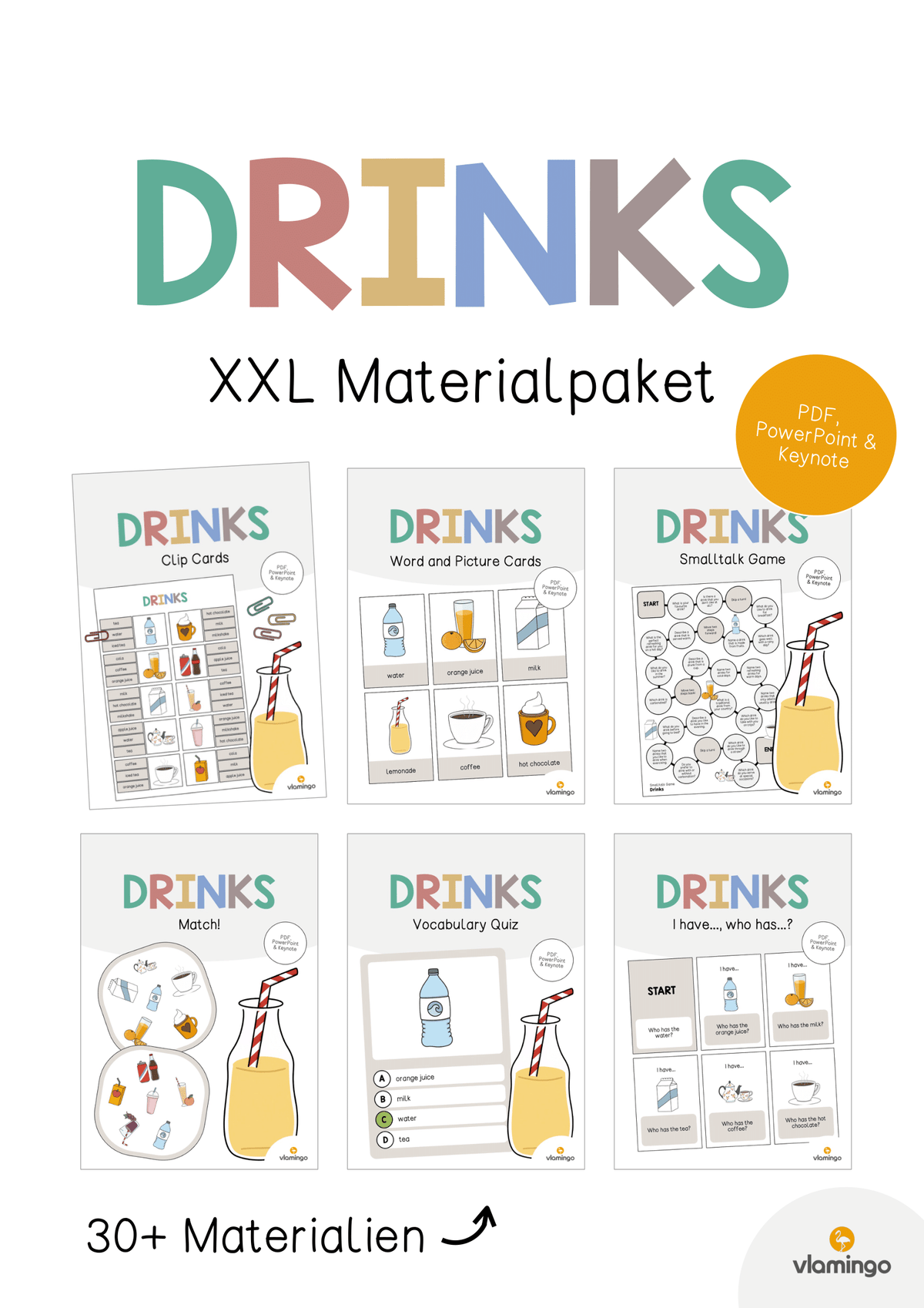


Teaching materials on the topic of drinks
Water, juice, milk or hot chocolate – drinks are topics that allow children to quickly draw on their own experiences. In English lessons, new words can therefore be easily introduced using familiar drinks, packaging and simple conversation situations.
The materials are intended for primary school and lower secondary school and can be used in Grades 1 to 6 depending on their scope and level of difficulty. Worksheets, picture cards, flashcards and educational games help children to learn important drinks in English and use them with increasing confidence.
Ways to use the materials in class
To start, the children can collect what they drink throughout the day. Which drinks do they already know in English? Which are hot and which are cold? New terms are then added and matched with suitable pictures.
Personal preferences can also be easily incorporated. The children can say what they like to drink, sort different drinks or match them with suitable cups, glasses and bottles. Later, this can lead to small ordering situations, for example with questions such as What would you like to drink?
Ideal for:
- Pair work
- Group work
- Station learning
- Independent work
- Weekly planning
- Remedial teaching
- Cover lessons
- Review phases
Learning objectives and skills promoted
The children learn important English words related to drinks and drinking habits. They recognize different drinks in pictures, match them with the correct terms and gradually use the vocabulary when speaking, reading and writing.
The vocabulary includes, for example, water, milk, juice, orange juice, apple juice, tea, coffee, hot chocolate, lemonade, soft drink, smoothie and milkshake. Depending on their level, words such as glass, cup, bottle, straw, hot, cold or thirsty can be added.
Simple sentence patterns are ideal, for example I like water, My favourite drink is …, I am thirsty or Can I have some juice, please? In this way, the children not only learn the words individually but also use them directly in small linguistic contexts.
Design and structure of the materials
Various materials are available on the topic of drinks. These include worksheets, flashcards, picture cards, word-picture cards, dominoes, bingo and memory games.
Picture cards and flashcards can be used for joint introductions or short reviews. On worksheets and in matching tasks, the children read and write the new words or connect drinks with the correct pictures. Dominoes, bingo and memory games add extra playful practice phases to the lesson.
Depending on the material, individual drinks, suitable containers, temperatures or small everyday situations are the focus. Individual tasks can be specifically selected or combined into a larger unit on drinks in English lessons.
File formats
- PowerPoint
The materials are available as PDF and PowerPoint files for download. After printing, they can be used directly in class. Editable PowerPoint files can be adapted to the desired vocabulary if necessary.
Didactic and methodological tips
Drinks can be introduced particularly easily using familiar objects. A juice carton, a water bottle or pictures of different drinks are often enough to collect initial words and get the children talking to one another.
Drinks can be easily combined with food and drinks, breakfast, lunch and dinner, parties, fast food, fruits or numbers. In this way, drinks can be matched with certain meals, bottles can be counted or preferences can be compared. Small ordering situations can also be incorporated according to the children's level.
Differentiation
For the introduction, a few familiar drinks such as water, milk, juice or tea are sufficient. Clear pictures help children quickly connect the English terms with the correct meaning.
Children with more language experience can learn additional drinks, express their preferences or formulate short orders. While some only match words and pictures, others can already read or write short statements about what they like to drink.