Carnival (Carnival / Fasching): Worksheets and teaching materials for English lessons
Worksheets, exercises and educational games on the topic of Carnival for primary school English lessons. The materials are particularly suitable for grades 3 and 4 and help students learn, practice and reinforce their English vocabulary related to carnival, Fasching, costumes and celebrations in a fun way. Ideal for classroom use, independent work, station learning or cover lessons – available as ready-to-use PDFs and PowerPoint presentations.

Filter
41 products






Teaching material on the topic of Carnival
Colorful costumes, masks, confetti and music – Carnival offers many exciting points of connection for English lessons. Children learn typical terms related to costumes, characters and celebrations, and can also revisit already known vocabulary related to colors, clothing, animals or professions.
The worksheets, educational games and teaching materials are suitable for primary school and lower secondary school and can be used depending on the content and difficulty level in Grade 1 to Grade 6. Picture cards, flashcards and various exercises enable an illustrative introduction to the topic of Carnival, Fasching and Fastnacht in English.
Possible uses of the material in class
The materials are particularly well suited for the Carnival and Fasching season and can be used both to supplement individual English lessons and for a small thematic series. As an introduction, various costumes and characters can be looked at and named together. Afterwards, the children can match words to pictures, describe costumes or review the new vocabulary in educational games.
The topic can be particularly well connected to already known content. What color is the costume? What is the character dressed as? Does the costume belong to an animal, a profession or a fantasy character? In this way, new vocabulary is directly linked to known English words.
Ideal for:
- Pair work
- Group work
- Station learning
- Independent work
- Weekly planning work
- Remedial teaching
- Substitute lessons
- Review phases
Learning objectives and skills promoted
Children expand their English vocabulary related to Carnival, Fasching and costumes. They learn typical characters, costumes and objects, recognize the English terms in pictures and increasingly use them when speaking, reading and writing.
The vocabulary includes, for example, carnival, costume, mask, clown, pirate, princess, superhero, confetti, balloon, parade, music and party. Depending on the level of learning, additional characters or descriptive words can be added.
As their confidence increases, the terms can also be incorporated into short sentences. For example, the children can describe a costume, name colors or say what character they would dress up as. In addition to vocabulary work, pronunciation, listening and reading comprehension, as well as writing simple English words and sentences, are promoted.
Structure and organization of the material
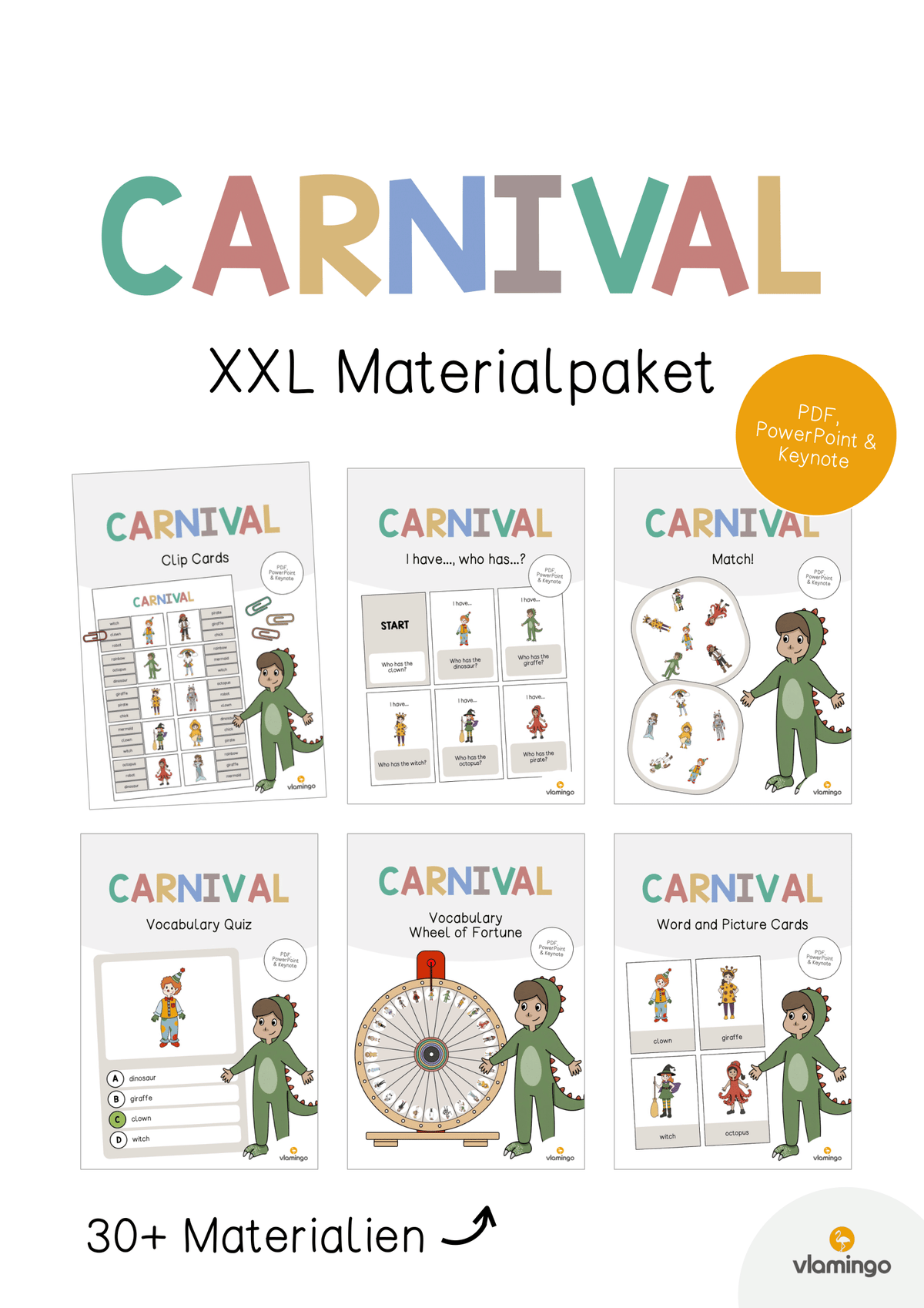
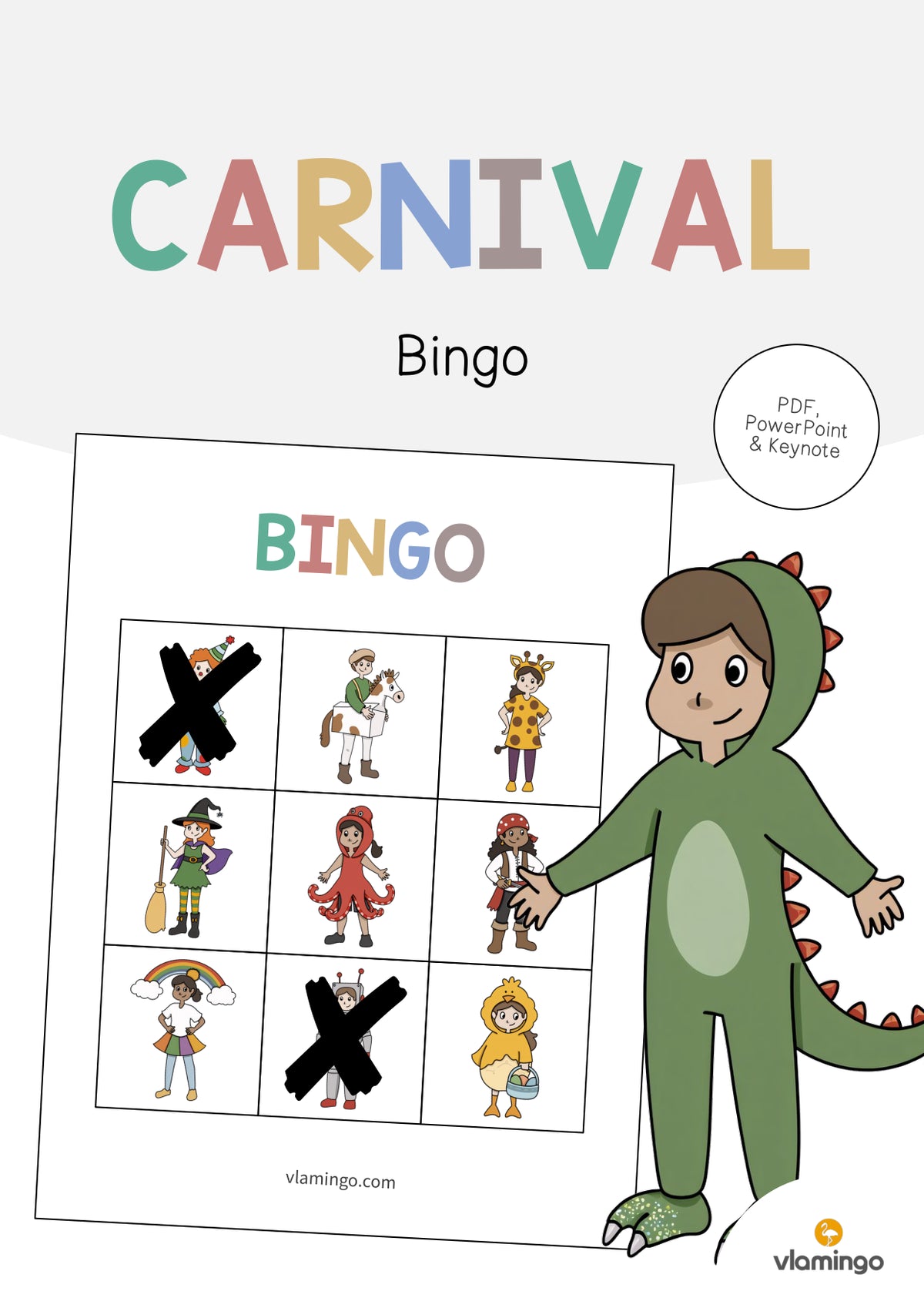
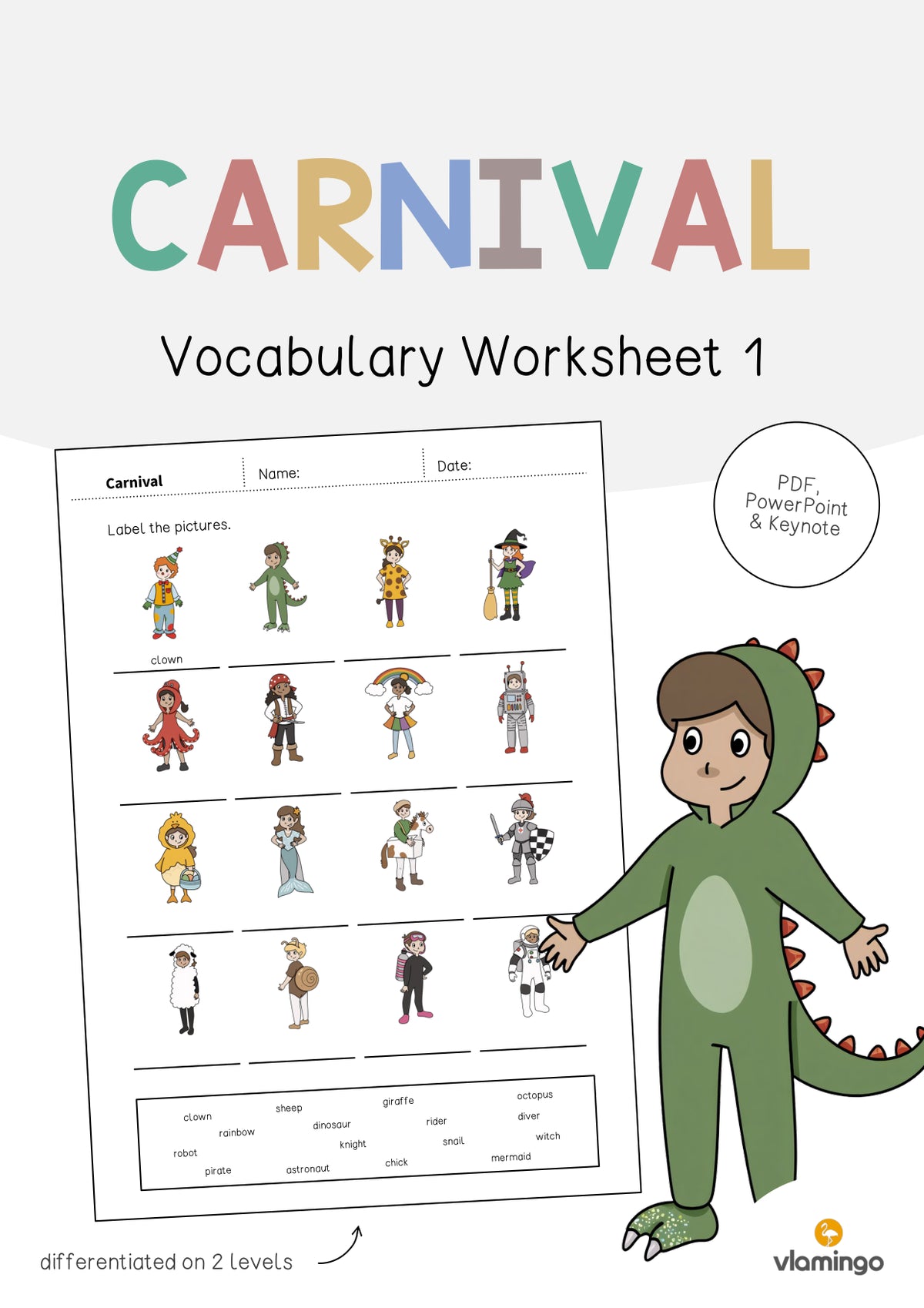
Various materials on the topic of Carnival are available, which can be used individually or combined with each other. These include worksheets, flashcards, picture cards, word-picture cards, dominoes, bingo and memory.
Picture cards and flashcards are particularly well suited for joint introductions and short reviews. On worksheets and with matching tasks, the children can then recognize, read, write the terms and match them to appropriate pictures. Educational games such as dominoes, bingo or memory provide additional opportunities for practice in pair and group work.
In terms of content, this includes costumes, masks, typical characters, confetti, balloons, parades and celebrations. Individual focus areas can thus be selected, or several materials can be combined into a small unit around Carnival in English lessons.
File formats
- PowerPoint
The materials are available as PDF and PowerPoint files for download and can be used directly after printing. Editable PowerPoint files can be adapted to the scope of the vocabulary and the level of the class if necessary.
Didactic-methodological tips
Costumes and dress-ups offer a particularly illustrative approach to the topic. Pictures or small guessing games can be used to introduce new terms while also reviewing already known words. Questions such as What is he wearing?, What colour is the costume? or What are you dressed as? also create simple opportunities for speaking.
Carnival can be easily connected with Clothes, Colours, Animals, Jobs, Feelings, Numbers or Party. Costumes can thus be described by color, characters counted, or various costumes matched to specific animals and professions. Known vocabulary is thus revisited in a new context.
Differentiation
For the introduction, work can initially be done with a few known characters and objects. Clear pictures and simple word-picture matching make access easier and help to firmly memorize the new terms.
Children with a larger vocabulary can include additional costumes, describe characters more precisely, or formulate short sentences about costumes. While some children recognize and match individual words, others can already describe a costume or explain what they would like to dress up as. This allows the materials to be flexibly adapted to different learning levels and paces.